Harold Bazin’s Grotto
All the Light We Cannot SeeHarold Bazin’s Grotto is a low, dripping space beneath the ramparts of Saint-Malo, entered through a gate and partly enclosed by ironwork. First remembered as a place for childhood play, it becomes a refuge for Marie-Laure LeBlanc when a threatening man pursues her, and later the setting for a quiet, consequential act beside the rising tide. Its narrow threshold offers temporary shelter, but the sea continually moves through it; the grotto holds safety and exposure, memory and uncertainty, in the same confined space.
Setting and Physical Character
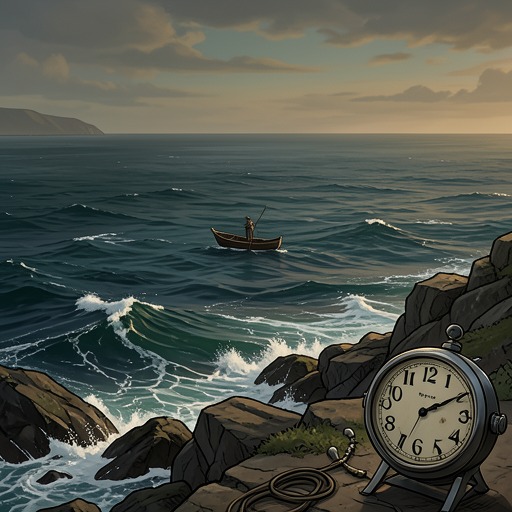
The grotto lies beneath the ramparts, at the end of a narrow alley partly veiled by hanging ivy. A gate opens into a low area bounded farther in by a grate. The route is familiar to Etienne LeBlanc, who remembers the place from childhood, but for others it is a hidden passage at the city’s edge. The air from the unseen ocean reaches through a gap in the wall, and the tide pushes water across the floor. At one visit it comes only to Marie-Laure’s shins; at another, she wades into a shallow pool. The water’s changing level makes time a physical pressure: whoever enters must reckon with the sea rising around them.
This is not an empty hiding place. Barnacles cling there, an anemone feels soft beneath Marie-Laure’s careful fingers, and a Nassarius snail draws into its shell when touched before extending its horns and moving again. The small creatures make her proceed cautiously, concerned not to crush them. Their slow return to motion contrasts with the human danger outside, while the encroaching tide prevents the scene from becoming a sealed refuge. The grotto shelters living things, but it does not stand apart from the forces surrounding it.
Marie-Laure’s Refuge and the Threat at the Gate
Marie-Laure comes to the grotto carrying a loaf in her knapsack. She closes the gate, lifts her dress hem, and steps into the shallow pool, attending to the creatures underfoot. The enclosed space offers a pause from the occupied city and a setting for her attention to narrow onto touch, movement, and the snail’s shell. That quiet is broken when a man reaches the entrance and speaks to her. She jerks away, clangs the gate shut in his face, locks it, pockets the key, and retreats with her cane into the low space of the kennel.
The gate gives her a barrier, not certainty. The man remains on its far side, and she hears him pacing with a lurching rhythm while water continues to flow into the grotto. She wonders whether the ironwork is too narrow for him to squeeze through and whether its hinges will hold. The imagined watchdogs that Harold Bazin once described—enormous, violent guardians of the place—become part of how she endures the wait. The grotto’s scale and darkness intensify the threat, but its gate also gives her a practical means of keeping the pursuer at a distance. Her fear is sharpened by the uncertainty of what he might do, not by any certainty that the enclosure can protect her indefinitely.
Childhood Memory and Rescue
For Etienne, the locked gate is also a door into an earlier life. He remembers a rusted entrance and a crumbling kennel where he played with his brother, Henri, and Harold Bazin. The small, dripping cavern had been a place where a boy could shout and dream. That memory supplies the route when Etienne realizes where Marie-Laure may have gone. He runs there with Madame Ruelle, following the paths of his youth by instinct and passing through the curtain of ivy to the same gate.
Inside, Marie-Laure is shivering, wet to her thighs, and still holding the ruined remains of the loaf. Her recognition of Etienne’s arrival turns the remembered childhood site into a place of immediate rescue. The scene joins two versions of the grotto without erasing their difference: what had once made room for play now protects a frightened girl from a pursuer. Etienne’s memory is useful precisely because the place has remained materially recognizable—the gate, the rampart, the dripping hollow—despite the altered conditions of war.
Return to the Tide and the Uncertain Hiding Place
Later, Marie-Laure leads Werner into the alley and toward the grotto. Civilians are leaving the city, but she tells him she needs only a moment. She produces a key, passes through the gate, and descends confidently, running her fingers along the walls as though greeting old acquaintances. The tide is already pushing a ripple through the pool. From her coat she takes a small wooden object and sets it in the water, then asks Werner whether it is in the ocean and insists that it must be. He confirms that it is in the water, but she asks again whether he is certain.
A later recollection returns to the grotto after Marie-Laure has walked out of the smoking city, carrying a white pillowcase. Werner goes back through Harold Bazin’s gate, beneath the crumbling rampart, with the sea settling on the far side of the grate. The remembered scene does not settle what happens to the diamond. He may solve the puzzle of the little house and drop the stone into the pool among the snails; he may put it back in the house or slip it into his pocket. The alternatives preserve the grotto as a place of unresolved transfer rather than a confirmed final resting place.
Narrative Significance
The grotto’s importance comes from its repeated crossings: the occupied streets give way to a hidden enclosure, childhood memory becomes a route to rescue, and a desperate hiding place becomes a possible destination for the Sea of Flames. The gate is at once a boundary against immediate danger and an entrance through which people return to the past. Inside, the tide and small marine creatures continue their ordinary movements while human lives are threatened and displaced. By leaving the stone’s fate open, the narrative makes the grotto more than a container for an object: it becomes the setting in which shelter, loss, and uncertainty remain inseparable.